
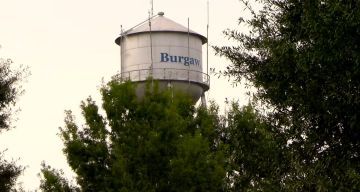
When Brian Allen became principal of Burgaw Middle School, he had never worked with Communities In Schools. The school was struggling with student behavior and had not met growth for several years.
“CIS really came into play that very first year,” Allen said. CIS Student Support Specialists began “push-ins,” working with BMS staff inside classrooms to help with behavior and create an environment where teachers could focus on teaching.
“Our student behavior was pretty significant at the time,” Allen said. “To control the classroom so that learning could happen, we really had to focus in on the student behavior. And that’s where CIS really came into play for that very first year where they were sliding into classrooms and they would help with classroom management.”
The partnership grew from there.
CIS Student Support Specialist Tarek Alvin works with students through classroom support and mentor groups.
“What we do is we talk about like discipline, focus, we talk about emotional intelligence and we try to get them to look at their behavior in a more critical manner,” Tarek said. “Just challenge them to think about the big picture, like ‘Where do you see yourself in 10 years?'”
Tarek said the support CIS provides also extends to teachers.
“That makes their jobs easier. And if you feel like your job is easier and you feel supported, you’re probably going to be more likely to perform at a higher level,” Tarek said.
For Tarek, the relationships with students are personal. He remembers struggling as a young person and having adults who saw potential in him when he didn’t see it himself.
“I was a troubled youth myself at one point,” Tarek said. “And you know, there were various talented, wonderful individuals in my life that stepped up and said, ‘No, young man, you’re going to turn yourself around.’ They didn’t have to do that.”
“That’s part of my why as to why I’m here, because of those individuals that didn’t give up on me and saw potential in me. Something I didn’t even see in myself. And that’s what I try to tell the youth, ‘I see something in you that you may not see in yourself I’m trying to get that out of you.’”
In School and Beyond
CIS also runs an afterschool program that serves about half of the school’s students. Students receive EOG tutoring, homework help, and then have time to participate in clubs, enrichment opportunities, play basketball and spend time with their friends.
Student Support Specialist Emily Marinan said the program is about more than keeping students busy after school.
“We live in an area that is Title 1 funded,” Emily said. ” If I get to keep them for three and a half hours extra a day, that’s three and a half hours extra with food, air conditioning, water, snacks, but also a place to be where they’re not getting in trouble. I want to provide a space that they want to come to and is geared towards them. And if they work hard, we play harder.”
The program gives staff another way to motivate students academically.
“It’s easier to get them into EOG tutor sessions for three hours a week every week because guess what we get to do after? Go play basketball all night and hang out, have some snacks, blast music in the gym. It’s fun,” Emily said.
Last year, students in the after-school program each completed about 67 hours of EOG tutoring. No student in the program saw their scores dip.
The school’s academic results, as reported by the North Carolina Department of Public Instruction, have changed as well. According to Mr. Allen, the school’s growth score went from -4.98 to +2.5, and the school moved from an “F” to a “C” over three years.
Allen said CIS was part of that change.
“The whole culture of the school changed,” he said. “CIS was a big part of that. And through the tutoring and through the relationship building with CIS, the push-in model, all those different things, we were really able to grow from year one to the end of year two.”
Allen also saw a change in how students viewed the program.
“You could just really see how much our students loved CIS,” he said. “It was a tool for us. It was a motivational, kind of a carrot that we could use to motivate the students.”
Tarek saw that motivation play out with one student who was struggling with grades and getting into trouble but wanted to participate in the after-school program.
“I said, ‘Look, I’ll make a deal with you. If you get your grades up and you stop getting in trouble all the time, I will talk with Miss M and I will try my hardest to get you in the program.'”
The student followed through.
“He straightened up,” Tarek said. “To go from where he was, to what he became. I was like, ‘Oh my God.’ But when he did follow through, I was like, ‘I got to be a man of my word here.'”
Even though the program was nearly full, Tarek worked with Emily to make room for him.
“We had to let him in,” Tarek said.
For Tarek, moments like this show the impact of the relationships built through CIS.
“Sometimes when we’re out in public, me and the other guys that lead the mentor group, the boys will come up and shake our hands and tell us how they’re doing and thank us for what we’re doing for them,” said Tarek.” I’m getting emotional right now just thinking about it. You can’t really put a price tag on that. Stuff like that just gives me hope and just makes me feel extra good about what we’re trying to do here.”
Allen sees the value of having CIS at the school in similar terms.
“We’re all here for the right reasons, and that’s helping kids,” he said.
For Emily, the work is personal.
“I don’t feel like I’m at a job while I’m here,” she said. “I am here for these kids. Not for me, not for anyone else. I love these kids. I love them.”